Uttarakhand Folk Music, Artists & Cinema
Uttarakhand Folk Music, Artists & Cinema represent a vibrant and living cultural tradition that has continued for centuries in the sacred land of Devbhoomi. In the villages and towns of Uttarakhand, music is not only heard but deeply felt during festivals, rituals, agricultural activities, and social gatherings. The main musical instruments and traditional musical arts reflect the spiritual and social life of the people.
Through this article, you will explore the important musical instruments of Uttarakhand, along with major folk artists, theatrical traditions, regional cinema, and the grand tradition of Ram Leela. This rich heritage has been preserved by generations and is still proudly performed across the Garhwal, Kumaon, and Jaunsar regions.
🎼 Classification of Musical Instruments in Uttarakhand
In the rich folk music tradition of the state, four main types of Vaad (instruments) are played:
1️⃣ Metal or Cubic Vaad
These instruments are made of metal and are mainly used for rhythm.
Examples: bell, binai, bronze thali, manjira, ghungroo, cymbals, kartal, tongs, and khajri.
2️⃣ Leather Instruments
Animal skin is stretched over wood or metal to produce deep sounds.
Examples: dhol, nagada, tabla, dafli, hudki, hudka, daur, damama (damaun), and dor (damru).
3️⃣ Wire or String Instruments
Melodies are created when strings vibrate.
Examples: sarangi, ektara, dotara, and veena.
4️⃣ Sushir (Wind) Instruments
These are played by blowing air.
Examples: trumpet, ransingha, conch (shankh), algoza (flute), mashkabeen, and mochang.
Among these, dhol, damaun, hudki, flute, nagada, sarangi, ransingha, ektara, and dafli are widely used today.
🥁 Major Musical Instruments of Uttarakhand
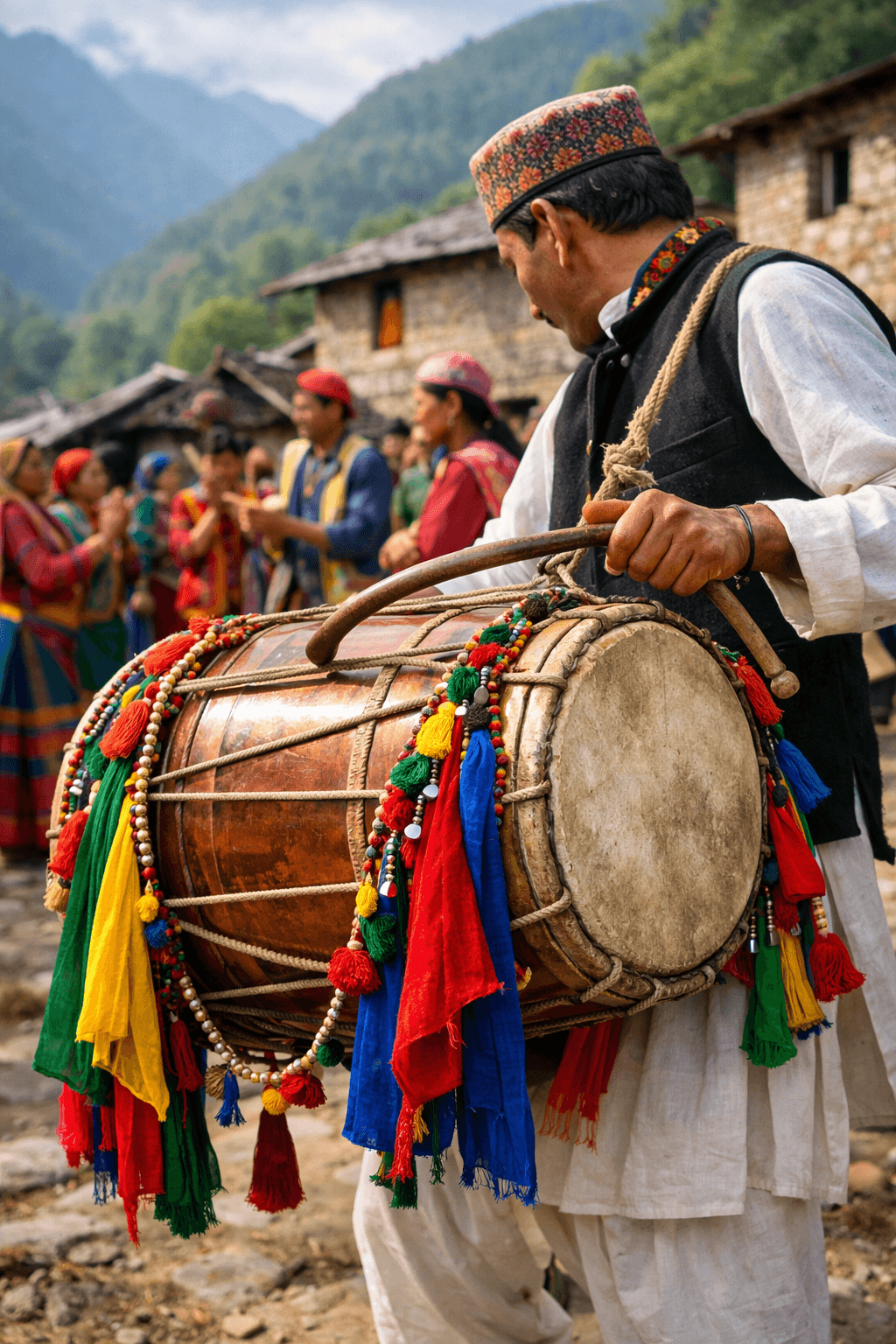
Dhol – The Heartbeat of Folk Music
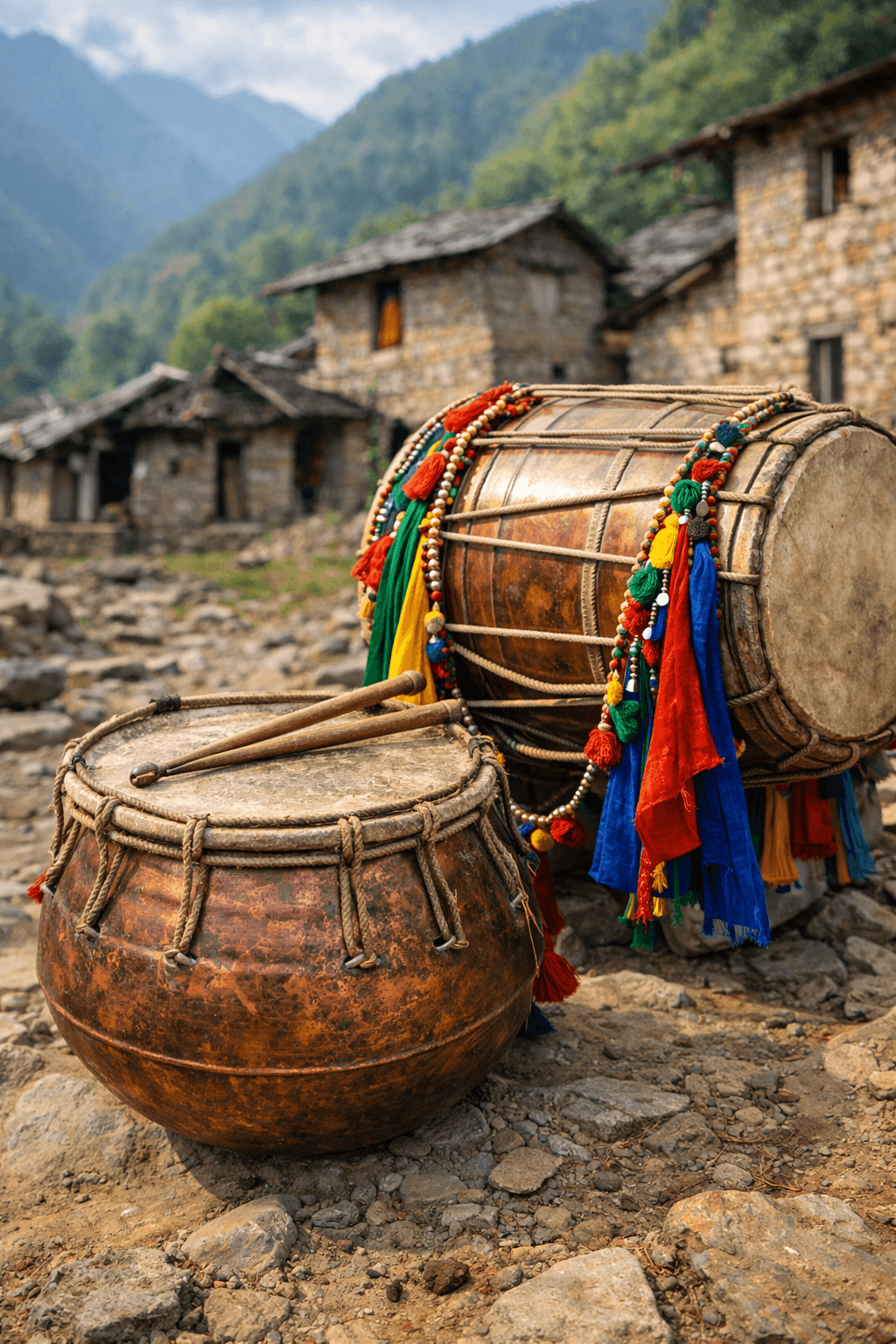
The dhol is considered the most prominent instrument of Uttarakhand. It is made from copper and sal wood. Goat skin is fixed on the left side, while buffalo or deer skin is mounted on the right. It is played during weddings, festivals, jagar rituals, and religious ceremonies. The rhythm of the dhol energizes the entire gathering, and its beats are accompanied by damaun.
Hudak or Hudki
Hudki is about one foot three inches long and covered with goat skin on both sides. It is played in war-motivational songs, jagar rituals, and agricultural activities. The larger one is called Hudak, while the smaller version is known as Saitya.
Damaun (Damama)
Damaun was earlier used in wars and royal courts, but today it is an essential folk instrument. It is bowl-shaped, made of copper, and covered with thick leather. A mesh of leather fibers is woven tightly to maintain its sound quality. It is always played with the dhol and supports its rhythm.
Binai
Binai is a small iron instrument that is pressed between the teeth and played with finger vibrations. Sweet sounds are produced through air movement. Unfortunately, this instrument is now on the verge of extinction.
Dor (Damru)
Dor or damru is made by hollowing solid wood and covering both ends with goat skin. It is played with the hands or sticks and produces intense and serious sounds. Unlike other leather instruments, it is not hung on the shoulder but played between the knees.
Mochang
Mochang is a thin iron instrument fixed on the lips and played with a finger. Due to lip air pressure and finger movement, melodious sounds emerge. Shepherds often play it in dense forests.
Duffle (Dafli Type)
Duffle is plate-shaped and covered with skin on one side. Ghungroos are attached to its frame to create melodious tones. Rhythms played on dholak, hudki, and dor are also presented on this instrument.
Mushkbeen
Mushkbeen is a European-origin instrument once used in army bands. It resembles a cloth bag with attached flutes and is played by blowing air through a pipe.
Ektara
Ektara is similar to a tanpura and has only one string. It is commonly used by traditional singers.
Stringed Instruments
These are widely used by professional singing communities like Badhi and Mirasi. They produce sweet melodies during dance and song performances.
Algoza (Flute)
Made of bamboo or ringal, the flute is played independently or with other instruments. It accompanies Khuded and Jhumila songs. Pastoral communities frequently play it.
Trumpet and Ranasingha
The trumpet and ransingha are copper wind instruments once used during wars. Today, they are played during deity dances and religious ceremonies.
Major Folk Artists of Uttarakhand
Garhwali, Kumaoni and Jaunsari artists have played a very important role in keeping the folk culture of Uttarakhand alive.
🎵 Garhwali Folk Singers (Female Artists)
- Kalpana Chauhan – Renowned Garhwali folk singer known for cultural and devotional songs.
- Vidhotmi Negi – Popular for traditional Garhwali performances.
- Rekha Dhasmana – Recognized voice in Garhwali folk music.
- Anuradha Nirala – Active performer in regional folk events.
- Meena Rana – Famous for both Garhwali and Kumaoni songs.
- Kabutri Devi – Traditional Garhwali folk artist.
🎼 Leading Garhwali Male Singers, Lyricists & Composers
- Jeet Singh Negi – One of the leading voices of Garhwali folk music.
- Narendra Singh Negi – Legendary Garhwali singer, composer, and lyricist.
- Ganesh Veeran – Prominent lyricist and musician.
- Santosh Khetwal – Known for Garhwali songwriting and singing.
🎶 Other Prominent Garhwali Folk Artists
- Jagdish Bakrola
- Pritam Bharatwan – Popularly known as a Jagar Samrat (master of Jagar singing).
- Mangalesh Dangwal
- Virendra Dangwal
- Virendra Rajput
- Gajendra Rana
🎵 Garhwali Singer-Songwriters & Musicians
- Anil Bisht – Singer and composer.
- Virendra Negi – Singer, lyricist, and composer.
- Rajendra Chauhan – Musician from Garhwal region.
- Sanjay Kumola – Folk singer and music contributor.
🔔 Jagar & Traditional Folk Artist
- Basanti Bisht – The most recognized female Jagar singer of Garhwal and Kumaon.
🎶 Kumaoni Folk Artists
- Chandra Singh Rahi – Kumaoni and Garhwali folk singer, songwriter, and music director.
- Hira Singh Rana – Kumaoni lyricist and folk singer.
- Bina Tiwari – Kumaoni folk singer.
- Girish Tiwari (“Girda”) – Renowned Kumaoni Janakavi (people’s poet).
- Sherda Anpadh – Famous Kumaoni Janakavi.
- Hema Dhyani – Kumaoni folk singer.
🎭 Jaunsari / Regional Folk Artists
- Suman – Johnsari / Bauri / Himachali regional singer.
- Ratan Singh Jaunsari – Jaunsari theatre artist, poet, and writer.
- Jagatram Verma – Jaunsari folk singer.
- Fakira Singh Chauhan – Jaunsari singer.
- Nandlal Bharti – Jaunsari singer and theatre personality.
Theatrical Arts & Cinema of Uttarakhand (Garhwali–Kumaoni Film History)
The theatrical arts of Uttarakhand, including regional cinema and Ram Leela traditions, reflect the deep cultural identity of the Garhwali, Kumaoni, and Jaunsari communities. Folk theatre and dialect-based films have played a vital role in preserving regional languages and social narratives.
🎬 History of Garhwali & Kumaoni Cinema
The history of cinema in the Garhwali–Kumaoni dialect began in 1981 with the release of the first Garhwali feature film:
🎥 Jagwal (Garhwali)
- Recognized as the first film of Uttarakhand (then Uttar Pradesh region).
- Produced by Pareshwar Godh.
- Lead actors: Pareshwar Godh, Ramesh Mendolia
- Lead actress: Kusum Bisht
From 1981 to 2009, approximately 58 Garhwali films and 4 Kumaoni films were released.
After 2005, due to declining cinema audiences, regional filmmakers increasingly shifted toward video film production, making films more accessible to rural viewers.
🌟 Major Garhwali & Kumaoni Movies
🎞 Gharjawen (Garhwali)
- Produced by Vishweshwar Dutt Nautiyal
- The only 35mm Garhwali film
- Released in 1985
- Ran for 29 consecutive weeks at Sangam Cinema, Delhi
- Considered the most successful Garhwali film
- Starred Balraj Negi and Shanti Chaturvedi
🎞 Choti Bawari (Garhwali)
- Dubbed version of the Hindi film Himalaya Ke Aanchal Mein
🎞 Pyaru Rumal (Garhwali)
- Dubbed from the Nepali film Kusume Rumal
🎞 Megha Aa (Kumaoni)
- Recognized as the first Kumaoni dialect film
🎞 Teri Saun (Garhwali)
- Produced and directed by Anuj Joshi
- Focused on the Uttarakhand Statehood Movement
🎞 Disciple (Kumaoni)
- Released in 2004
🎞 Amar Shaheed Sridev Suman
- Released in 2007
- Based on the life of freedom fighter Sri Dev Suman
🎞 Chalda Jatra
- The only documentary film representing the Jaunsari region
🎞 Yaad Aali Tehri
- Directed by Anuj Joshi
- Released in 2010
- Based on emotional and social themes linked to Tehri
🎭 Ram Leela Tradition in Uttarakhand
Ram Leela is one of the most important theatrical traditions of Uttarakhand.
- Organized in almost all regions of the state.
- In some areas, it is performed during Dussehra.
- In other regions, it is staged after the harvesting of the Kharif crop.
The most renowned style is:
🎭 Ramleela
Particularly famous is the Kurmanchaliya Ram Leela, which is considered the Almora-style Ram Leela, originating from the Kumaon region.
Conclusion
The major musical instruments and musical arts of Uttarakhand showcase the spiritual, cultural, and social identity of the state. From the powerful beats of the dhol and damaun to the soulful melodies of the flute and sarangi, every instrument tells a story. Folk artists, regional cinema, and Ram Leela traditions continue to preserve this rich heritage.
If you are passionate about Uttarakhand’s history and culture, explore more detailed articles on our website and discover the timeless traditions of Devbhoomi.