
Tourism and Religious Places Haridwar
Haridwar Tour Place
I will tell you today about ‘Hariddhar Tour Palace’ which is also called Dwar of Uttarakhand, from where Uttarakhand has also started, the place from where the journey of Char Dham starts is the place ‘Hariddhar Tour Palace’ from where you can visit. can understand uttarakhand
Uttarakhand is a prosperous state from the point of view of natural and religious tourist places. According to the State Statistics Diary 2011-12, there are a total of 264 tourist places here. Apart from this, there are many other sightseeing and religious places as well. Tourism is becoming a major source of income and employment of the state. Therefore, the state government is arranging for a comprehensive action plan and resource framework by formulating a multi-dimensional tourism policy for the planned and rapid development of this area.
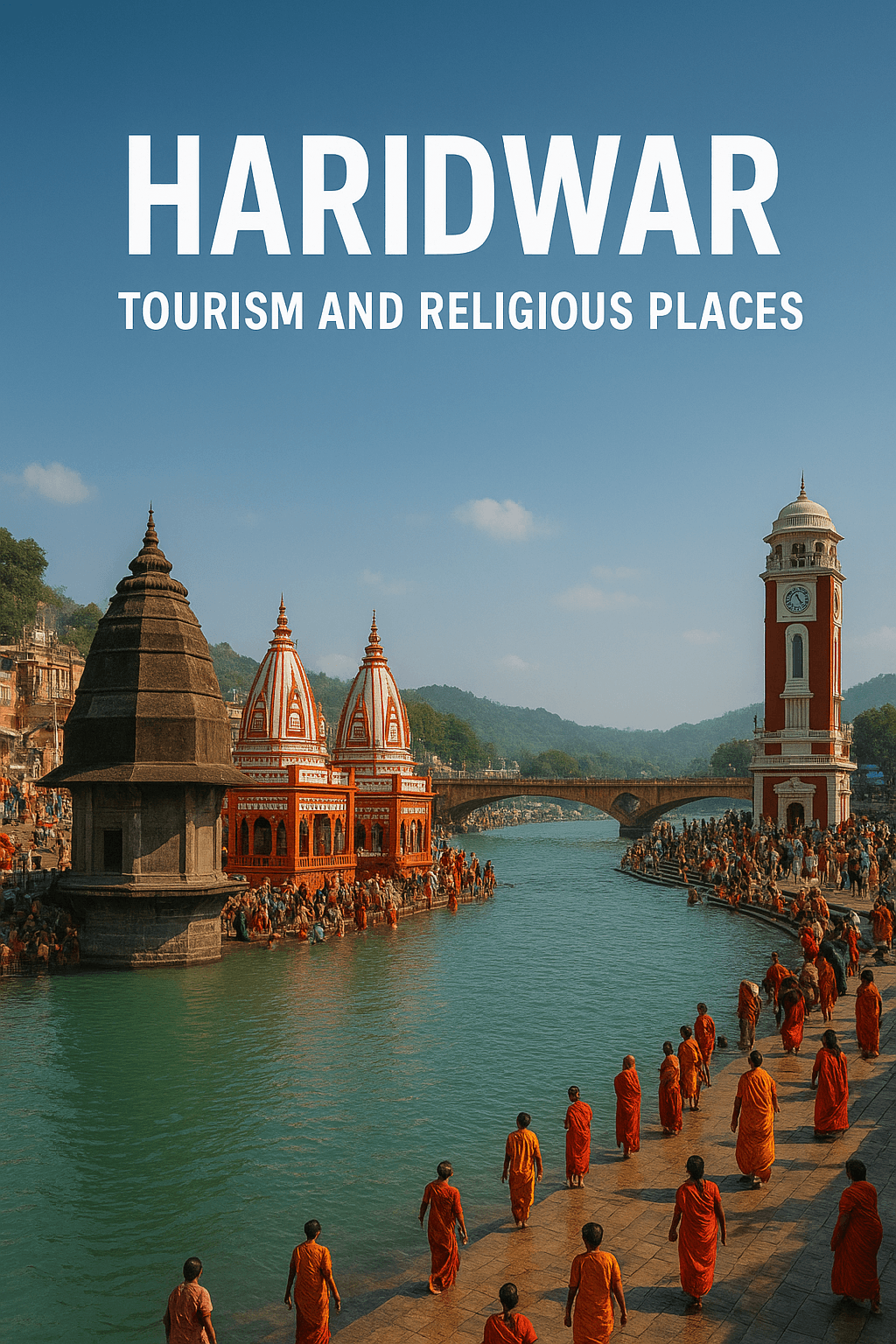
Places to Visit in Haridwar
Introduction to Haridwar
Haridwar is a very special city in the Garhwal region, which is situated on the right bank of the Ganges between the Bilb and Neel mountains of the Shivalik range. From here the Ganges descends into the plain.
It was formed as a district on 28 December 1988. From 1988 till the formation of the state, it was in Saharanpur division, but after formation it has been made a district of Garhwal division.
Ancient Names of Haridwar
In the Puranas and Sanskrit literature, it has been designated by the names Gangaddhar, the gateway of the gods, the gateway of pilgrimage places, the gate of the four dhams, the gateway to heaven, Mayapuri or Mayakshetra etc.
The worshipers of Shiva who go on the journey to Kedarnath, connecting it with Shiva, are called ‘Harddhar’ and the Vaishnavites who travel to Badrinath are called ‘Hariddhar’.
Mythological Importance of Haridwar
Kapil Muni and the Story of King Sagar
Kapil Muni had an ashram here before the Ramayana period. In which the Ashwamedha Yagya horse of the Suryavanshi king Sagar was secretly tied by Indra.
While searching for the horse, 60,000 Sagar sons reached the ashram and said abusive words to Kapil Muni and were consumed by the sage’s curse.
Later, Sagara’s descendant Bhagirath, after doing penance, made the Ganga descend on the earth and saved his ancestors by passing the Ganges from here. Haridwar is also called Kapil after the name of Kapil Muni.
Khandavvan and the Pandavas
According to ancient historians, the forest of this region was famous as ‘Khandavvan’, in which the Pandavas hid during their ajatvash.
Dhritarashtra, Gandhari and Vidura
Dhritarashtra, Gandhari and Vidura had renounced their bodies here and Vidura narrated the Mahabharata story to Maitreya Rishi.
Sapta Rishi and Seven Streams of Ganga
The Ganga had to flow through seven streams here because of the Sapta Rishis doing penance at this place.
Archaeological and Cultural References
Historians have considered it as a city with ocher pottery culture, whose period lasts between 1200 BC to 1700 years.
According to Jain texts 1000 years ago, the first Jain pilgrim Lord Adi Nath did penance while staying in Mayapuri (Hariddhar) area.
King Bhartrihari and King Vikramaditya
About 2056 years ago, King Bhartrihari, the elder brother of King Vikramaditya of Ujjain, did penance on the Shivalik range of Haridwar and composed two great texts (Nitishtak and Vairagya Shatak).
King Vikramaditya had built Paudhiyo (steps) on the Ganges here in memory of his brother, which was called Bhartrihari ki Paidi. In the course of time, this became everyone’s foot.
Vikramaditya had also built a building here, which in the form of ruins is still located near Har ke Paidi by the name of Datwali Haveli.
Foreign Travelers and Historical Accounts
Chinese Traveler Hansang
The Chinese traveler Hansang came to Haridwar in the year 634. He called this city “Mo-U-Lo” and Ganga as Mahabhadra. Cunningham takes the meaning of Mo-U-Lo from Mayurpur.
Timurlang’s Visit
Timurlang also came here in 1399. His historian Saruddin refers to Haridwar as ‘Kayopil’ or ‘Kupila’, which according to Cunningham is Koh-pari. Koh means mountain. Saruddin had also seen here the footprints of Vishnu on the banks of the Ganges.
Mughal Period References
Akbar’s historian Abul Fazl writes in ‘Ain Akbari’ that Maya has been known as Haridwar. He also writes that only Gangajal was used in Akbar’s kitchen. Akbar used to pour this water from Haridwar in large pots.
Akbar’s general Mansingh had renovated Harki Paidi in Haridwar and also laid the policy of modern Haridwar on the ruins of the ancient city. He got the old narrow ghat built and made an octagonal pillar in the middle of the Ganges stream and donated it to a monk by writing a copper sheet to be used as a place of worship. This pillar still stands today.
European Travelers
The first European traveler, Tom Caryat, came to Haridwar during the reign of Jahangir in 1608. He called Haridwar the capital of Shiva. Jahangir himself was coming to Haridwar for a few days in 1620.
Religious Developments
After the arrival of Ramananda (1400–1470), the Ramanand sect and the Vaishnava wave established Haridwar as the main pilgrimage center for Hindus.
During the reign of the Gorkhas, Haridwar became the center of sale for the slaves.
British Period and Archaeological Survey
Alexander Kerningham, the director general of the Archaeological Survey of India, run by the British government, conducted an archaeological survey between 1862 and 1865.
According to his report, Ganga Dwar, Harki Paidi, Mayadevi Temple, Bhairav Temple, Narayanbali Temple and Rajaven Fort were the major sites in Haridwar at that time.
Karnigham had found the statue of Mercury in the Shravanatha temple here from the samadhi site under the Bodh tree.
Keeping in view the importance of Haridwar, the British paid special attention to its development.
Visit of Mahatma Gandhi
Mahatma Gandhi visited Haridwar in 1915 and 1927.
Main Religious and Sightseeing Places in Haridwar
The main religious and sightseeing places here are –
- Har Ki Paidi
- Brahmakund
- Kangra Temple
- Subhash Ghat
- Kushavartghat
- Gau Ghat
- Shravannath Temple
- Ancient Ganga Neel Dhara
- Mahamaya Devi Temple
- Shri Mansa Devi Temple
- Bhimgoda Kund
- Jairam Ashram
- Bharat Mata Temple
- Saptarishi Ashram
- Vishnucharan Paduka Temple
- Sri Ganga Temple (built by Man Singh)
- Athkhamba Temple
- Gangadhar Mahadev Temple or Ganga-Bhagirathi Temple
- Gayatri Temple (Shantikunj)
- Nileshwar Mahadev
- Shri Lakshmi Narayan Temple
There is a grand temple of ‘Makarvahini Ganga’ of South style established by Jagadguru Shankaracharya Jayendra Saraswati of Kanchi Kamakoti Peet. This temple has an idol of Ganga in black stone.
Five Important Mythological Places of Haridwar
The five places which have been mentioned as important in the mythological texts are –
- Har Ke Paidi
- Kushavarta
- Nildhara
- Kankhal
- Bilva Parvat
Harki Paidi (Brahmakund)
First of all the holy ghat here was built by King Vikramaditya in the memory of his brother Bhartrihari.
Akbar’s general Raja Mansingh had rebuilt Harki Paidi anew.
This holy bathing ghat is also known as Brahma Kund.
It is believed that bathing here brings salvation.
This is the first part. To read the second part, you can go to the Haridwar category on Learn & Learn.
Other Posts Here:⇓
Uttarakhand Metahistoric Period
Edison Wave Digital Hearing Offer
Pingback: Chamoli (Gopeshwar) Part 1