Medieval Period of Uttarakhand
The medieval period of Uttarakhand witnessed the rise and fall of powerful dynasties, the construction of strategic forts, and continuous political struggles in both Kumaon and Garhwal. This era is remembered for the Katyuri rule, the expansion of the Chand dynasty, and the establishment of the Parmar (Panwar) dynasty in Garhwal. Many details of this period are still preserved in local folklore, Jagar, and historical manuscripts.
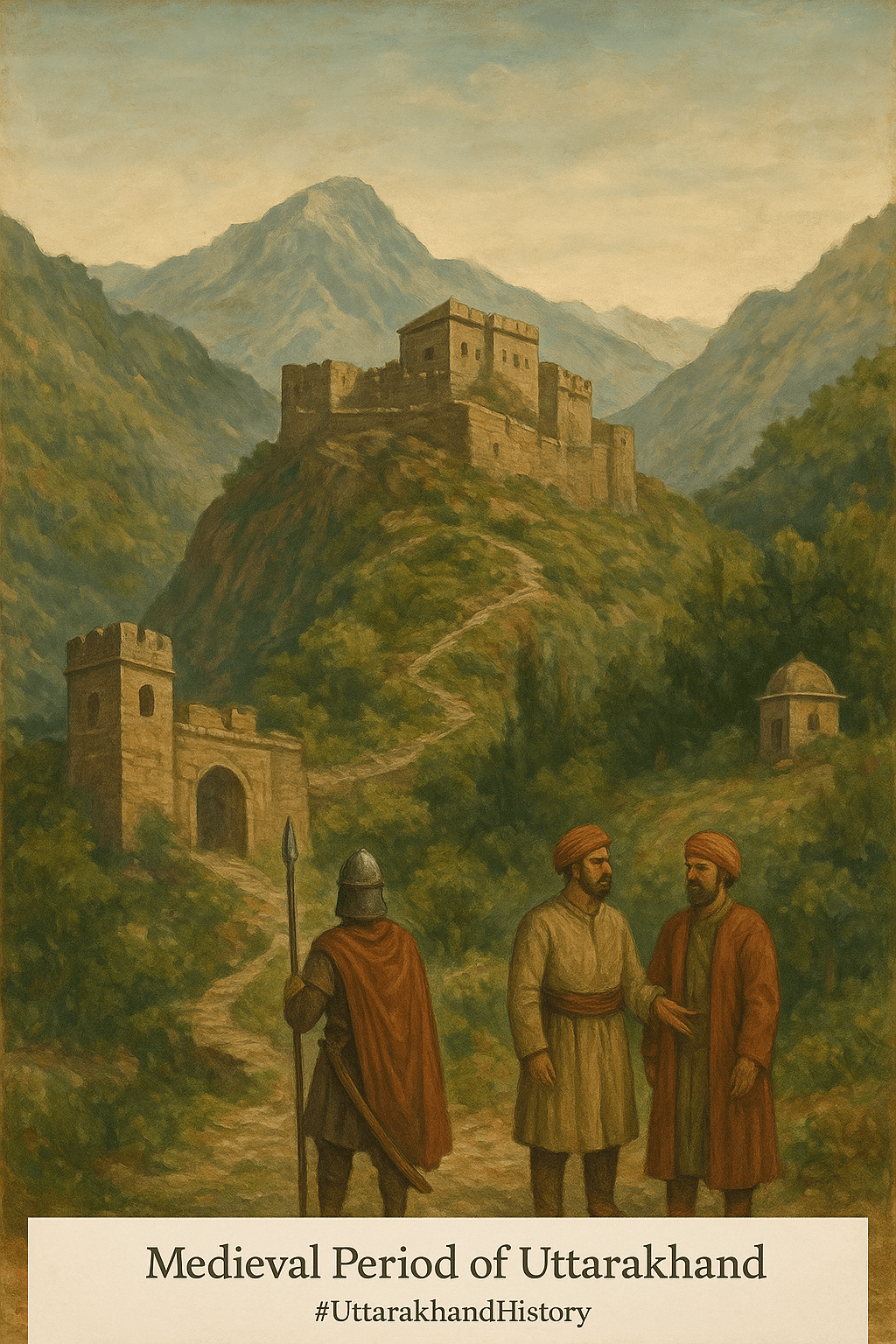
Katyur or Katyur Ruler
Information about the Katyuri rule of medieval Kumaon is mainly obtained from local folk tales and Jagar traditions. According to oral history, the Katyuri dynasty was established after the Karthikeyapur kings. Over time, as the Katyuris weakened, their kingdom fragmented, and several new branches emerged—such as the Baijnath, Pali-Pachhaun, Askot, Doti, Sera, and Sore branches.
Asantideva established the Asantideva branch and shifted the capital from Joshimath to Ranchulakot.
The last ruler,Brahmdev, was considered tyrannical and is referred to asVeeramdev in Jagar.
According to the Jiarnari folk saga, Brahmdev confronted Timur Lang during his 1398 AD attack on Haridwar. After this, the dynasty weakened and eventually ended.
In1191 AD, King Ashokchala of Western Nepal attacked the Katyuri kingdom.
In 1223 AD, Kachaldev of Dulu (Nepal) also attacked Kumaon and captured Katyuri areas.
Chand Dynasty of Kumaon
In the early medieval period, the Chand and Katyuri dynasties coexisted, leading to frequent conflicts. Eventually, the Chand dynasty became dominant in Kumaon. Its founder was Thoharchandra (1216 AD).
Initially, their rule was limited to Champawat, but later it expanded to Nainital, Almora, Pithoragarh, and parts of Nepal.
Due to the growing territory,Bhishmachandra shifted the capital from Champawat to Almora (1512–1530), completed later under Kalyan Chandra III in 1560.
The most powerful ruler was Garud Gyan Chand, while Baj Bahadur Chand resisted Tibetan invasions.
During Kalyan Chandra IV’s rule (1743–45), Kumaon suffered a major Rohilla attack, and the Garhwal king Pradip Shah helped defend the region.
The Chand rulers promoted religion and art. King Rudra Chand wrote Triveni Dharmanirnaya and Usha Rudra Godya, while Roop Chandra wrote Shayanik Shastra.
The poetShiva composed Kalyana Chandrodayam during Kalyan Chandra IV’s era.
Village headmen (patwari or pradhan) were appointed during this period for land settlement.
Their state emblem was the cow, used on coins and seals.
Mughal texts like Jahangirnama and Shahnama mention relations between the Mughals and Chand kings. Arabic, Persian, and Turkish words entered Kumaoni language during this period.
In 1790 AD, the Gorkhas defeated the last Chand king Mahend Chand at Hawalbagh and captured Almora, ending Chand rule.
Major Forts of Kumaon Region
Kharmra Fort
Built to the east of Almora by King Bhishmachandra (1555–60).
Lalmandi Fort
Constructed in 1563 by Raja Kalyanchandra in Paltan Bazar, Almora. It is also known as Fort Moira.
Malla Mahal Fort
Located in the middle of Almora city. Built by Kalyanchandra, it currently houses the Collectorate and court buildings.
Rajbunga Fort
Situated in Champawat, constructed by King Somchand of the Chand dynasty.
Naithra Fort
Located near Masi on the Ramnagar–Ganai road. It is believed to be a Gorkha-era structure.
Sirmohi Fort
This fort lies in Sirmoli village (Lohaghat), considered an ancient defensive structure.
Banasura Fort
Situated on a high peak 7 km from the Lohaghat–Devidhura road. Its length is 80 m and width 20 m.
Local legends say it was built by Demon King Banasura, and locally it is called Markot.
Parmar (Panwar) Dynasty of Garhwal
Until the 9th century, Garhwal was ruled by 54 small Thakuri (Khas) chiefs. Due to limited military power, they built forts for defense. Among them, Raja Bhanupratap of Chandpurgarh was the strongest.
In 887 AD, Kanakpal from Dhar (Gujarat) visited Garhwal as a pilgrim. Bhanupratap married his daughter to Kanakpal.
In 888 AD, Kanakpal founded the Parmar dynasty at Chandpurgarh.
The early rulers were vassals of the Karthikeyapur kingdom but became independent by the 10th–11th century.
Ajaypal (1500–1519) unified Garhwal by defeating the small Garh chiefs.
He shifted the capital from Chandpurgarh to Devalgarh, and then to Srinagar (1517).
Mughal emperor Bahlol Lodi is believed to have given the rulers the title “Shah’’, which later became traditional.
Garhwal extended into parts of present-dayHimachal Pradesh.
Key Medieval Events
In1636, Mughal commander Nawazt Khan attacked Doon Valley, but Queen Karnavati defended it and became known as Nakkati Rani for cutting off the noses of invading soldiers.
Despite repeated invasions, Garhwal was never annexed by the Mughals.
Garhwal kings Manshah and Mahipatishah resisted Tibetan attacks.
After capturing Kumaon in 1790, the Gorkhas attacked Garhwal in 1791, but were defeated and forced to pay annual tax.
In 1803, Gorkhas again invaded under Amar Singh Thapa during a massive earthquake and captured most of Garhwal.
King Pradyumn Shah was killed in the Battle of Khudbura (1804).
His son Sudarshan Shah sought British help. The Anglo-Gorkha War (1814–15) ended Gorkha control.
Due to unpaid war expenses, the British annexed eastern Garhwal, and the remaining area became Tehri State.
Garhwal Kings After Pradhuman Shah
Sudarshan Shah (1815–1859)
Partition of Garhwal
Capital shifted to Tehri on 28 December 1815
Bhavani Shah (1859–1871)
Pratap Shah (1871–1886)
Introduced English education in Tehri
Sir Kirti Shah (1886–1913)
Received the title CSI in 1898
Narendra Shah (1913–1946)
People’s movement for Praja Mandal and independence from princely rule
Manvendra Shah (1946–1949)
Supported the freedom movement
Praja Mandal formed in 1948
On 1 August 1949, Tehri merged with India and became a district of Uttar Pradesh
The oldest copper plate inscription of this dynasty belongs to King Jagatpal (1455 AD), discovered in the Raghunath Temple of Devprayag.
Conclusion
The medieval period of Uttarakhand displays a complex yet fascinating blend of dynastic rule, cultural development, military struggles, and architectural heritage. From the rise of the Katyuri, the dominance of the Chand, and the consolidation by the Panwars, the region’s history is filled with valor, folklore, and political evolution.