Welcome to the FAQ / Help section of Singhu Day Blog. Here you will find answers to common questions about Uttarakhand history, culture, dynasties, rivers, temples, and research sources.
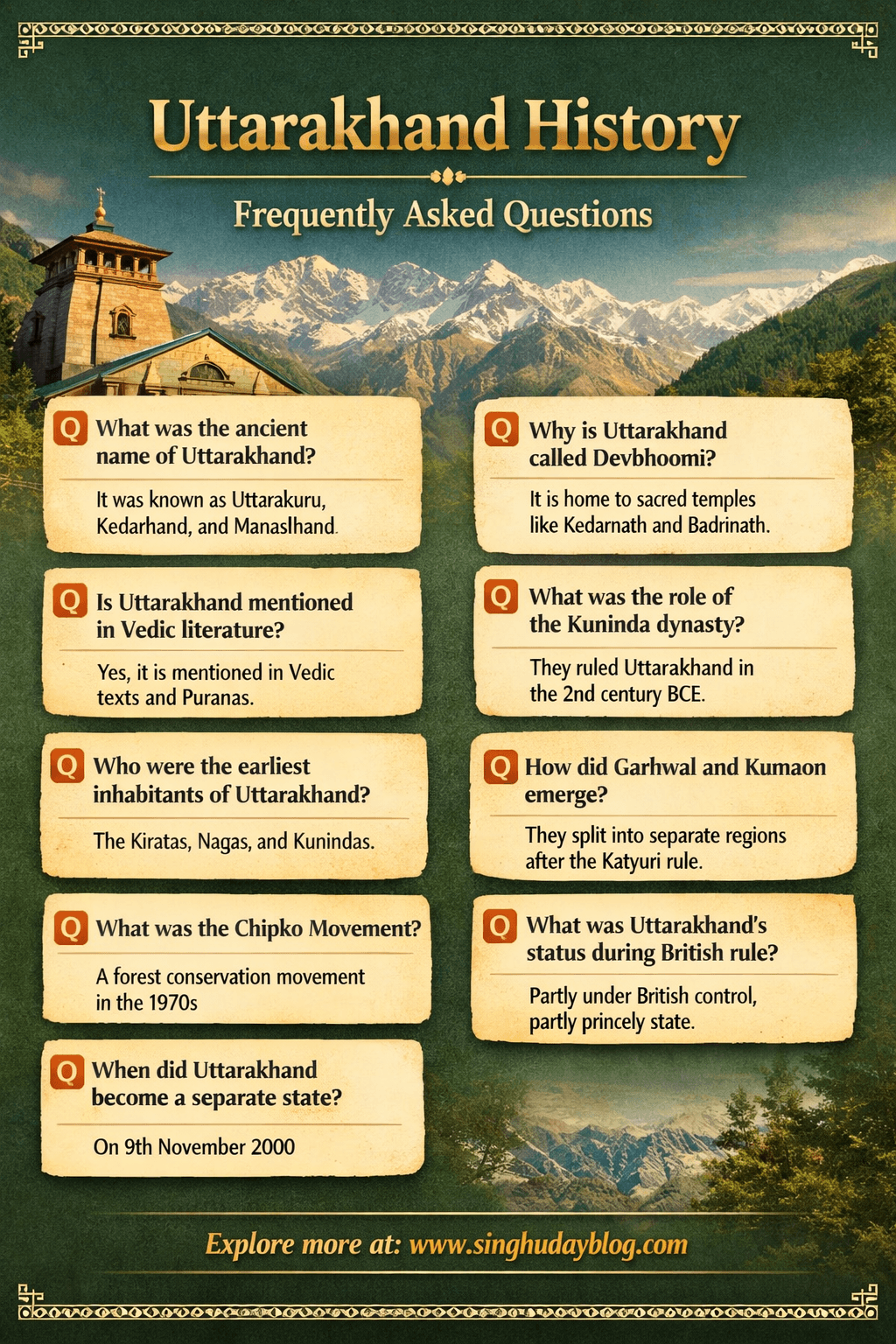
1. What was the ancient name of Uttarakhand?
⇒Uttarakhand was known by several ancient names such as Kedarkhand, Manaskhand, and Uttarakuru, as mentioned in Hindu scriptures.
2. Is Uttarakhand mentioned in Vedic literature?
⇒Yes, Uttarakhand is mentioned in Rigveda and other Vedic texts as a sacred land inhabited by sages and saints.
3. Why is Uttarakhand called Devbhoomi (Land of the Gods)?
⇒Uttarakhand is home to holy pilgrimage sites like Badrinath, Kedarnath, Gangotri, and Yamunotri, which is why it is called Devbhoomi.
4. Who were the earliest inhabitants of Uttarakhand?
⇒The earliest inhabitants included groups such as Kol, Kirat, and Khasa, who lived in the Himalayan region in ancient times.
5. What was the role of the Kuninda dynasty in Uttarakhand history?
⇒The Kuninda dynasty played an important role in ancient Uttarakhand by issuing coins and promoting trade and culture.
6. Katyuri vansh ka itihas kya hai?
⇒Katyuri vansh (9vi–12vi shatabdi) ne Kumaon aur Garhwal par shasan kiya. Baijnath aur Dwarahat ke mandir isi kaal ke pramukh udaharan hain.
7. How did Garhwal and Kumaon emerge as separate regions?
⇒After the decline of the Katyuri dynasty, the region fragmented into smaller kingdoms, leading to the emergence of Garhwal and Kumaon as separate entities.
8. What was Uttarakhand’s status during British rule?
⇒During British rule, Kumaon and Garhwal were administered as part of the United Provinces, bringing administrative and educational reforms.
9. What was the Chipko Movement?
⇒The Chipko Movement (1970s) was an environmental movement in Uttarakhand where villagers hugged trees to prevent deforestation.
10. When did Uttarakhand become a separate state?
⇒Uttarakhand was formed on 9 November 2000 as the 27th state of India.
11. Which are the major historical sites in Uttarakhand?
⇒Major historical sites include Jageshwar, Baijnath, Katarmal Sun Temple, Lakhu Udiyar caves, Pandukeshwar, and Golu Devta Temple.
12. How is Uttarakhand’s folk culture linked to its history?
⇒Folk songs, dances, and festivals such as Jhoda, Chholiya, Harela, and Phool Dei are deeply connected to Uttarakhand’s ancient traditions and nature worship.
13. What are the main historical sources of Uttarakhand history?
⇒Important sources include Puranas (Skanda Purana – Kedarkhand), accounts of Chinese travelers, inscriptions, and British-era records.
14. Why is Uttarakhand history important to study?
⇒Studying Uttarakhand history helps us understand Himalayan culture, environmental awareness, and the evolution of Indian civilization.
15. Why is Uttarakhand history important for students and researchers?
⇒Uttarakhand history is significant for UPSC, UKPSC, and academic research as it highlights regional heritage and identity.